John Wooden is a genuine monument under the American basketball Coaches. There it was Headcoach with UCLA of 1948-75 and won in its last 12 years 10 NCAA championships, under it 7 in consequence. From 1971-74 it went 88 times into consequence as a winner out of resounds. In its book "Practical decaying basketball" (1966) it describes the principles for basketball Coaches, most important from its view, which have at that time like today their validity.
Check out John Wooden's page here
Further important principles:
1. Basketball is play of the habits, and it needs time and patience, in order to develop correct habits and turn bad off. One of the largest errors of most inexperienced coaches is probably the lack of patience. The players try to convince of the fact that her in training to become careless never to be allowed, because they will exactly the same play, as they train. Constant concentration on the goal is must.
2. The coach and the players may never will content, but constantly to work to become better. Set for you perfection to the goal, although it can be never achieved.
3. It remembers that it is is so important, as much you do, but like well you make many more it. It is better to train some things correctly well when too many different, by which nothing is then controlled correctly. Zumute to your players not too much.
4. Do not take the players so much to the short line that you lose their selfinitiative. They must have but must also to the action of a fellow player to react correctly be able a certain freedom of choice, in order to keep the room layout.
5. Attempts to sketch a balanced Offense which supplies a same number of throw possibilities for each player position, but confuse the players not by the fact that you make it too complicated in the tendency to bring in your whole knowledge.
6. Do not ignore the small details, because there is the small things, which can make the difference. Perfection in some slight details is often the only difference between winners and losers.
7. You must prepare win in order to be a winner, and you cannot prepare others, without being prepared. Self-assurance gets off to be prepared and in good condition.
8. Convince your players of the fact that condition is often the crucial factor at two similarly strong and well prepared teams. However they, if they want to use their better condition, must have pressure already early in the play for the opponent, so that them make themselves paid at the end. Bases, patience and self-assurance leave you in the measure, how the fatigue increases, then ensure for the fact that your opponents become tired, before you become it.
9. Use a positive beginning around pride on your own play to develop, both defensively and offensively. Prepare you for your opponents, but never make for you concerns because of them. Leave it deinetwegen themselves to ensure.
10. Attach great importance on the play without ball in the attack and to the defense against an aggressor without ball.
11. Do not forget to emphasize your Playmaker and defense specialists with each opportunity publicly too. Basket contactors get anyway enough applause around their Ego to strengthen, but the others may not be forgotten thereby.
12. The coach should take over a criticizing, and it should be always constructional. Do not permit a player to criticize a fellow player somehow to draw up or to scoffed.
13. It insists on the fact that the basket contactors itself always with the fellow player, whose passport led to its basket, thanked you and all this to its fellow player applause donate, which implemented a straight good action.
14. Constantly analyze you and your players and let you from the result of this analysis lead.
Tuesday, June 20, 2006

John Wooden
John Wooden is a genuine monument under the American basketball Coaches. There it was Headcoach with UCLA of 1948-75 and won in its last 12 years 10 NCAA championships, under it 7 in consequence. From 1971-74 it went 88 times into consequence as a winner out of resounds. In its book "Practical decaying basketball" (1966) it describes the principles for basketball Coaches, most important from its view, which have at that time like today their validity.
Check out John Wooden's page here
The five fundamental principles:
There are many important principles, which are to be considered, if one tries to train a basketball team and to form it to perfectly functioning unit. Despite the difficulty to select from it the most important I made from five things the hitting a corner columns and the core of my success pyramid, a mythischen structure for you me help should have done to become clear me over my basketball philosophy.
1. Diligence: There is no replacement for work. The coach and its players must work hard, since all worthwhile goals can be attained only by careful planning and hard work. Perfection can be never achieved, but it must be the goal on which one purposefully worked. One can never achieve its goal, by looking for a simple way for an abbreviation or.
2. Enthusiasm: Coach and players must be basketball-inspired. If not, they should look for each other another occupation. Enthusiasm colors on everyone off, which comes with it into contact, and enthusiasts tend to drag others along. You must be with the heart with the work, if you want to be successful, since it makes you for avid to learn new and improve you.
3. Condition - mentally, morally and physically: The mental and moral condition of your players is of extreme importance, because it determines the physical condition, if the players are industrious and inspired. A player, who is not mental and morally reliable, will never be in physical Topform, because it develops destroyed instead of.
The mental and moral example set by the coach can have a strong influence on the type of player, whom it forms, and of still larger importance for the character of the young people, which begin later its Obhut abandoned and with it to lead others.
4. The bases - Fundamentals: The coach must make its players familiar carefully with the bases of the play, and obtain the ability to use these correctly in play. They must learn to react fast and correctly without hesitating and about their decisions to think have. It is a Binsenweisheit in the basketball that that, which hesitates loses. The whole basis for solid play is the fast execution of the basic techniques. A exzellente execution of the bases can possibly compensate a bad play tactics, in addition, the best system cannot adjust unsatisfactory control of the bases. The coach must go surely that he never permits itself to dedicate to a complicated play system so much time that he from the training of the bases "steal it" must.
5. Development of team spirit: The coach must use all his psychological abilities and possibilities of developing a good team spirit in its crew. Teamwork and unselfishness must be encouraged with each opportunity, and each player must be not only ready on it avid, to sacrifice its personal fame for the well-being of the team. Egoism, envy, Ichbezogenheit and mutual criticism can destroy the team spirit and ruin the potential of each team. The coach must realize itself that it and be constantly attentive, in order to prevent such developments by the fact that it already packs it at the root, before problems develop.
Check out John Wooden's page here
The five fundamental principles:
There are many important principles, which are to be considered, if one tries to train a basketball team and to form it to perfectly functioning unit. Despite the difficulty to select from it the most important I made from five things the hitting a corner columns and the core of my success pyramid, a mythischen structure for you me help should have done to become clear me over my basketball philosophy.
1. Diligence: There is no replacement for work. The coach and its players must work hard, since all worthwhile goals can be attained only by careful planning and hard work. Perfection can be never achieved, but it must be the goal on which one purposefully worked. One can never achieve its goal, by looking for a simple way for an abbreviation or.
2. Enthusiasm: Coach and players must be basketball-inspired. If not, they should look for each other another occupation. Enthusiasm colors on everyone off, which comes with it into contact, and enthusiasts tend to drag others along. You must be with the heart with the work, if you want to be successful, since it makes you for avid to learn new and improve you.
3. Condition - mentally, morally and physically: The mental and moral condition of your players is of extreme importance, because it determines the physical condition, if the players are industrious and inspired. A player, who is not mental and morally reliable, will never be in physical Topform, because it develops destroyed instead of.
The mental and moral example set by the coach can have a strong influence on the type of player, whom it forms, and of still larger importance for the character of the young people, which begin later its Obhut abandoned and with it to lead others.
4. The bases - Fundamentals: The coach must make its players familiar carefully with the bases of the play, and obtain the ability to use these correctly in play. They must learn to react fast and correctly without hesitating and about their decisions to think have. It is a Binsenweisheit in the basketball that that, which hesitates loses. The whole basis for solid play is the fast execution of the basic techniques. A exzellente execution of the bases can possibly compensate a bad play tactics, in addition, the best system cannot adjust unsatisfactory control of the bases. The coach must go surely that he never permits itself to dedicate to a complicated play system so much time that he from the training of the bases "steal it" must.
5. Development of team spirit: The coach must use all his psychological abilities and possibilities of developing a good team spirit in its crew. Teamwork and unselfishness must be encouraged with each opportunity, and each player must be not only ready on it avid, to sacrifice its personal fame for the well-being of the team. Egoism, envy, Ichbezogenheit and mutual criticism can destroy the team spirit and ruin the potential of each team. The coach must realize itself that it and be constantly attentive, in order to prevent such developments by the fact that it already packs it at the root, before problems develop.
Advantages of participation in basketball!!
Advantages of participation in basketball!!
1. Opportunity to develop your physical strength to the fullest using the most modern equipment, and under the direction of people who really care about your health.
2. Develop responsiveness to group discipline. You may not have been involved, but you must learn that sometimes that doesn't matter. In all of life, you are guilty by association. It's a great learning tool for you.
3. Develops lasting friendships.
4. Develops self-confidence.
5. Develops respect for rules and authority. Helps you overcome negative attitude when all things don't go your way. (Things don't always go your way.)
6. Opportunities for development of cooperation, dedication, sportsmanship, initiative and unselfishness.
7. Travel opportunities enable you to see other communities and get acquainted with other types of people. Everyone lives differently. All communities are different.
8. Play experience tends to make a person more friendly, interesting and human.
9. Opportunity to participate in an activity that parallels many later life experiences.
10. Draws attention to yourself which may have a business and educational value later on. Newspaper and radio exposure may help you get a job.
11. Successful participation may also open the door to such vocational values as coaching, athletic training or pro participation.
12. Ability to make the team has helped many individuals through high school and college.
13. It can also be very very fun.
1. Opportunity to develop your physical strength to the fullest using the most modern equipment, and under the direction of people who really care about your health.
2. Develop responsiveness to group discipline. You may not have been involved, but you must learn that sometimes that doesn't matter. In all of life, you are guilty by association. It's a great learning tool for you.
3. Develops lasting friendships.
4. Develops self-confidence.
5. Develops respect for rules and authority. Helps you overcome negative attitude when all things don't go your way. (Things don't always go your way.)
6. Opportunities for development of cooperation, dedication, sportsmanship, initiative and unselfishness.
7. Travel opportunities enable you to see other communities and get acquainted with other types of people. Everyone lives differently. All communities are different.
8. Play experience tends to make a person more friendly, interesting and human.
9. Opportunity to participate in an activity that parallels many later life experiences.
10. Draws attention to yourself which may have a business and educational value later on. Newspaper and radio exposure may help you get a job.
11. Successful participation may also open the door to such vocational values as coaching, athletic training or pro participation.
12. Ability to make the team has helped many individuals through high school and college.
13. It can also be very very fun.
Sunday, June 11, 2006
Basketball overseas vip pack!
This is a great new basketbal information! It has everything and so much more you could ask for! It covers things such as Your Guide To Setting Goals, How To Use Creatine While Playing Basketball, How To Find, Apply For and Receive College Scholarships, The Ultimate Resource of College and Universities, and even Basketball Goals Worksheets!

So it doesn't matter what your looking for. Rather your wanting just improve and set goals. This specail is for athletes, business people and anyone who wants to be successful. Or if your looking to find scholarships and send in impressive applications that stand out from the pack. It's all right here so what are you wanting for check this out today!
So it doesn't matter what your looking for. Rather your wanting just improve and set goals. This specail is for athletes, business people and anyone who wants to be successful. Or if your looking to find scholarships and send in impressive applications that stand out from the pack. It's all right here so what are you wanting for check this out today!
Wednesday, May 10, 2006
jump rope simulation
Jump Rope Simulation - 10 seconds each, 3 sets as fast as you jump
a. 2-foot jump - feet shoulder-width apart
b. Right leg only
c. Left leg only
d. Jumping jack
e. Wide base - feet as wide as possible (stay wide)
f. Split legs forward and back (switch as quickly as you can)
a. 2-foot jump - feet shoulder-width apart
b. Right leg only
c. Left leg only
d. Jumping jack
e. Wide base - feet as wide as possible (stay wide)
f. Split legs forward and back (switch as quickly as you can)
Cuban being himself!
The other day NBA fined Mark Cuban $200,000. Can you believe that there are so many people in this world that would like to make $200,000. Where Mark Cuban is getting fined that much. Anyways, this fining cames after Mark goes onto the court after Game 1 of Dallas' series against the Spurs and criticizing league officials on his blog, ESPN's Jim Gray is reporting.
Actually, Cuban was only fined $100,000 for the actions of going on the court. Then another $100,000 for is BLOG! Yes get his one! Cuban was fined $100,000 for being critical of the league regarding the selection of playoff officials, and how to improve playoff officiating on blogmaverick.com.
"The NBA knows all, does all, and far be it for me to question any of this." Cuban told Gray.
Cuban also said that he wrote the article before the playoffs and simply reposted it after Game 1.
Cuban was punished eight times for more than $1 million and suspended from three games in his first two years after buying the Mavericks in 2000.
Actually, Cuban was only fined $100,000 for the actions of going on the court. Then another $100,000 for is BLOG! Yes get his one! Cuban was fined $100,000 for being critical of the league regarding the selection of playoff officials, and how to improve playoff officiating on blogmaverick.com.
"The NBA knows all, does all, and far be it for me to question any of this." Cuban told Gray.
Cuban also said that he wrote the article before the playoffs and simply reposted it after Game 1.
Cuban was punished eight times for more than $1 million and suspended from three games in his first two years after buying the Mavericks in 2000.
Monday, May 08, 2006
How to Get More from Your Bench Players
How to Get More from Your Bench Players
1. Establish role for your players (i.e. defense, passsing, three point shooting)
2. Try to get subs in early (end of first quarter and during second quarter).
3. Reward players for their efforts in practice with more playing time.
4. Getting players in the game early gives them confidence if they are needed later.
5. Getting players in early gives you one less thing to think about down the stretch.
6. Matchup your substitutions with your opponent's.
7. Establish positive relationships between first stringers and reserves.
8. Work with second team during practice.
9. Get all your players ready to contribute.
10. Use different combinations and different starting lineups
11. Take kids out of the game on a positive note, if possible.
12. Don't yank kids out of a game after one bad pass or missed layup.
13. Make all kids feel involved in the game and your program.
14. Give kids opportunities to see why they are not getting more playing time or playing with the first unit.
15. Talk and explain substitution process when possible.
1. Establish role for your players (i.e. defense, passsing, three point shooting)
2. Try to get subs in early (end of first quarter and during second quarter).
3. Reward players for their efforts in practice with more playing time.
4. Getting players in the game early gives them confidence if they are needed later.
5. Getting players in early gives you one less thing to think about down the stretch.
6. Matchup your substitutions with your opponent's.
7. Establish positive relationships between first stringers and reserves.
8. Work with second team during practice.
9. Get all your players ready to contribute.
10. Use different combinations and different starting lineups
11. Take kids out of the game on a positive note, if possible.
12. Don't yank kids out of a game after one bad pass or missed layup.
13. Make all kids feel involved in the game and your program.
14. Give kids opportunities to see why they are not getting more playing time or playing with the first unit.
15. Talk and explain substitution process when possible.
Thursday, May 04, 2006
Defense stats
Defense stats, what to look for for defensive stats. Here are some stats or things you can keep track of that may never really show up on the stat sheet. Here are some ideas to be studying or looking for such as deflections, which is the number of times you get a hand on the ball with your activity. Look for the number of loose balls we get, you can also track of the number of charges that taken and you can chart and track the percentage of shots that are contested with a hand in the shooters face. Those are all very telling statistics in terms of defensive posture and disposition.
Monday, May 01, 2006
basketball success
The key to success is to believe there are no keys - just success!
SUCCESS
Sucess is giving your best effort consistently.
Trying your best in each activity of each day is
the goal. When that is done, I believe success
has been achieved, regardless of the apparent result.
-Ed Schilling
Every man is enthusiastic at times. One man has enthusiasm for thirty minutes, another for thirty days -- but it is the man who has it for thirty years who makes a success in life.
The secret of success is to be like a duck -- smooth and unruffled on top, but paddling furiously underneath.
Try not to become men of success. Rather, become men of value.
"It is better to fail in originality than to succeed in imitation."
- Herman Melville
Success is never final. Failure is never fatal. It's courage that counts.
"Success has ruined many a man."
- Benjamin Franklin
"Success in life comes not from holding a good hand, but in playing a poor hand well."
- Denis Waitley & Rem L. Witt
One thing that keeps a lot of people from being a success is work.
To be successful, you have to keep moving. After all, no one stumbles sitting down.
"It is hard to fail, but it is worse never to have tried to succeed."
- Teddy Roosevelt
"Failure doesn't mean you are a failure...it just means you haven't succeeded yet."
- Robert Schuller
"Success is a piece of mind which is a direct result of self-satisfaction in knowing that you did your best to become the best you are capable of becoming."
- John Wooden
"In great attempts it is glorious even to fail."
- Wilfred A. Peterson
At God's footstool to confess,
A poor soul knelt and bowed his head.
"I failed." He cried. The master said,
"Thou didst thy best, that is success."
A man may make mistakes but he isn't a failure until he starts blaming someone else.
"Talent is the gift plus the passion -- a desire to succeed so intense that no force on earth can stop it."
- Neil Simon
If you don't risk anything, you risk even more.
"Failure isn't fatal unless you let it be."
- Mike Ditka
Success consists of thinking ahead, of considering future consequences, and of taking consequences based on those considerations.
The three most important steps you will take: the last step, the first step, the next step.
You become successful by helping others become successful.
"Most players prepare for disaster. A good player prepares for success."
- Tony Alfonso
"Those who want to succeed will find a way; those who don't will find an excuse!"
- Leo Aguila
"The very moment one becomes BOUND and DETERMINED, is the very moment one becomes UNBOUND by what his or her previously limited thinking and circumstances had DETERMINED."
- Brian G. Jett
Success is knowing the difference between cornering people and getting them in your corner.
When facing a difficult task, act as though it is impossible to fail. If you're going after Moby Dick, take along the tartar sauce.
Don't accept 'good enough' as good enough.
Don't say you don't have enough time. You have exactly the same number of hours per day that were given to Helen Keller, Louis Pasteur, Michelangelo, Mother Theresa, Leonardo Da Vinci, Thomas Jefferson, and Albert Einstein.
There is no limit to the goals you can attain, the success you can achieve -- your possibilities are as endless as your dreams.
"In front of excellence, the immortal gods have put sweat, and long and steep is the way to it."
- Hesiod, Philosopher
"If we had no winter, the spring would not be so pleasant; if we did not sometimes taste of adversity, prosperity would not be so welcome."
- Anne Bradstreet
"Most of the important things in the world have been accomplished by people who have kept on trying when there seemed to be no hope at all."
- Dale Carnegie
"The secret of getting ahead is getting started."
- Sally Berger
"The more you love what you are doing, the more successful it will be for you."
- Jerry Gillier
Do not stare up the steps to success, step up the stairs.
The door to the room of success swings on the hinge of determination.
"Experience shows that success is due less to ability than to zeal. The winner is he who gives himself to his work, body, and soul."
- Charles Buxton
"For all sad words of tongue or pen,
The saddest are theses: It might have been!"
- John Greenleaf Whittier
"He that is over-cautious will accomplish little."
- Johann Friedrich Von Schiller
"All you need in this life is ignorance and confidence, and then success is sure."
- Mark Twain
"You cannot reach your goals unless you first stretch your imagination."
- Brian G. Jett
There are many ways to measure success; not the least of which is the way your child describes you when talking to a friend.
SUCCESS
Sucess is giving your best effort consistently.
Trying your best in each activity of each day is
the goal. When that is done, I believe success
has been achieved, regardless of the apparent result.
-Ed Schilling
Every man is enthusiastic at times. One man has enthusiasm for thirty minutes, another for thirty days -- but it is the man who has it for thirty years who makes a success in life.
The secret of success is to be like a duck -- smooth and unruffled on top, but paddling furiously underneath.
Try not to become men of success. Rather, become men of value.
"It is better to fail in originality than to succeed in imitation."
- Herman Melville
Success is never final. Failure is never fatal. It's courage that counts.
"Success has ruined many a man."
- Benjamin Franklin
"Success in life comes not from holding a good hand, but in playing a poor hand well."
- Denis Waitley & Rem L. Witt
One thing that keeps a lot of people from being a success is work.
To be successful, you have to keep moving. After all, no one stumbles sitting down.
"It is hard to fail, but it is worse never to have tried to succeed."
- Teddy Roosevelt
"Failure doesn't mean you are a failure...it just means you haven't succeeded yet."
- Robert Schuller
"Success is a piece of mind which is a direct result of self-satisfaction in knowing that you did your best to become the best you are capable of becoming."
- John Wooden
"In great attempts it is glorious even to fail."
- Wilfred A. Peterson
At God's footstool to confess,
A poor soul knelt and bowed his head.
"I failed." He cried. The master said,
"Thou didst thy best, that is success."
A man may make mistakes but he isn't a failure until he starts blaming someone else.
"Talent is the gift plus the passion -- a desire to succeed so intense that no force on earth can stop it."
- Neil Simon
If you don't risk anything, you risk even more.
"Failure isn't fatal unless you let it be."
- Mike Ditka
Success consists of thinking ahead, of considering future consequences, and of taking consequences based on those considerations.
The three most important steps you will take: the last step, the first step, the next step.
You become successful by helping others become successful.
"Most players prepare for disaster. A good player prepares for success."
- Tony Alfonso
"Those who want to succeed will find a way; those who don't will find an excuse!"
- Leo Aguila
"The very moment one becomes BOUND and DETERMINED, is the very moment one becomes UNBOUND by what his or her previously limited thinking and circumstances had DETERMINED."
- Brian G. Jett
Success is knowing the difference between cornering people and getting them in your corner.
When facing a difficult task, act as though it is impossible to fail. If you're going after Moby Dick, take along the tartar sauce.
Don't accept 'good enough' as good enough.
Don't say you don't have enough time. You have exactly the same number of hours per day that were given to Helen Keller, Louis Pasteur, Michelangelo, Mother Theresa, Leonardo Da Vinci, Thomas Jefferson, and Albert Einstein.
There is no limit to the goals you can attain, the success you can achieve -- your possibilities are as endless as your dreams.
"In front of excellence, the immortal gods have put sweat, and long and steep is the way to it."
- Hesiod, Philosopher
"If we had no winter, the spring would not be so pleasant; if we did not sometimes taste of adversity, prosperity would not be so welcome."
- Anne Bradstreet
"Most of the important things in the world have been accomplished by people who have kept on trying when there seemed to be no hope at all."
- Dale Carnegie
"The secret of getting ahead is getting started."
- Sally Berger
"The more you love what you are doing, the more successful it will be for you."
- Jerry Gillier
Do not stare up the steps to success, step up the stairs.
The door to the room of success swings on the hinge of determination.
"Experience shows that success is due less to ability than to zeal. The winner is he who gives himself to his work, body, and soul."
- Charles Buxton
"For all sad words of tongue or pen,
The saddest are theses: It might have been!"
- John Greenleaf Whittier
"He that is over-cautious will accomplish little."
- Johann Friedrich Von Schiller
"All you need in this life is ignorance and confidence, and then success is sure."
- Mark Twain
"You cannot reach your goals unless you first stretch your imagination."
- Brian G. Jett
There are many ways to measure success; not the least of which is the way your child describes you when talking to a friend.
Saturday, April 29, 2006
Our hats off to Joakin Noah
We applaud Joakim Noah decide though it was probably hard, we just want to personally thank him for his decision of showing off his true character. And also, setting what we here think is a great example for young kids today. This is truly a lesson to learn kids stay in school. Though, we know Noah had a hard decision, but just think about it. If he goes to the NBA, the carefree days of college life is over, and over in a hurry. Though, everyone and especially media is going to say well if he doesn't go now he is going to cost himself money, chances of top pick, and etc.
Though our rebuttal to all that is...whatever happend to education first, to education is money, and caring more of the future through education. That's what we feel here is the most important.
A perfect example of this is look at Jay Williams, or some might know him has Jason Williams from Duke. Oh yea where is he now? Do you see him in NBA?
Ultimately, Jason Williams decided to take a chance and go back to school. And though at the time, people thought he was crazy. Now knowing what we all know. I think people are saying it was a pretty smart move!
Jump ahead two years, to Jay William's motorcycle accident in June 2003, right after his rookie season with the Chicago Bulls. That's when he discovered his decision to stay in school was pretty good after all.
At Duke his junior year, and even after that, he admits this is where he formed a lot of connections, and that turns out to be the one of the most valuable things he recieved from staying in school.
When he was injured, he automatically was able to reach out to people and find opportunities and find something to do with myself. He was able to use his degree from Duke (If he had graduated after my junior year and entered the NBA) and he had so many sources of support and contacts that he don't think he would have had if he had left after his sophomore year.
That's when he realized the importance of his college years. That's something that ever athlete should come to realize.
We just want to say again Thanks to Joakin Noah for being a little different these days!
Though our rebuttal to all that is...whatever happend to education first, to education is money, and caring more of the future through education. That's what we feel here is the most important.
A perfect example of this is look at Jay Williams, or some might know him has Jason Williams from Duke. Oh yea where is he now? Do you see him in NBA?
Ultimately, Jason Williams decided to take a chance and go back to school. And though at the time, people thought he was crazy. Now knowing what we all know. I think people are saying it was a pretty smart move!
Jump ahead two years, to Jay William's motorcycle accident in June 2003, right after his rookie season with the Chicago Bulls. That's when he discovered his decision to stay in school was pretty good after all.
At Duke his junior year, and even after that, he admits this is where he formed a lot of connections, and that turns out to be the one of the most valuable things he recieved from staying in school.
When he was injured, he automatically was able to reach out to people and find opportunities and find something to do with myself. He was able to use his degree from Duke (If he had graduated after my junior year and entered the NBA) and he had so many sources of support and contacts that he don't think he would have had if he had left after his sophomore year.
That's when he realized the importance of his college years. That's something that ever athlete should come to realize.
We just want to say again Thanks to Joakin Noah for being a little different these days!
Kobe's nasty dunk!
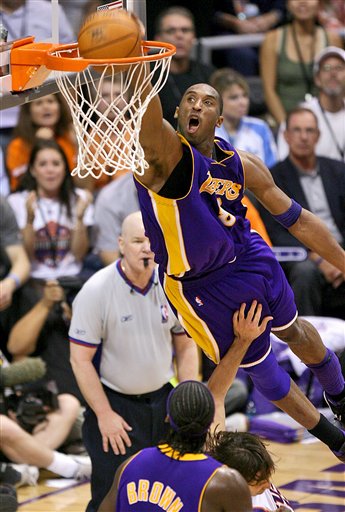
This was a nasty dunk for Kobe! WOW, where was the MVP on that play!! The thing that is impressing me the most, and I honestly don't know where the credit is due if not to all. That the Lakers look like a completely different TEAM! I state team meaning that it was Kobe before, but now it's actually TEAM with energy and fire! I don't know if that's Phil Jackson, Kobe, or what. But, I am actually enjoying and especially with highlights like this!
Thursday, April 27, 2006
Why do you love this game
The NBA, African Americans Love This Game!
*Professional Basketball is entering its All-Star break and on this date we look at its Black history. As a team sport it has been transformed by the presence of African-Americans.
This story has progressed with the cultural, political, and social changes in the United States for more than 100 years. The game was created in 1891; African-Americans entered the ranks of professional players (the NBA) in the 1950s. Since then, it has become one of the most popular and exciting games in the world. Black players in the NBA have helped to transform the game into a billion-dollar industry.
The games culture has become important as fashion, with logos of American professional teams found on the clothing the world over. But with the elegance and power of black athleticism capturing the respect and admiration of the world, for years it was isolated, as segregation split America along racial lines. Some of the earliest all-black club teams, were the Smart Set Athletic Club of Brooklyn, New York, the St. Christopher's Club of New Jersey, and the Loendi Club from Pittsburgh, Pennsylvania, produced high-scoring, action-packed games. Eastern club teams in New York, New Jersey, Washington, D.C., and Philadelphia, Pennsylvania, astonished crowds. Two of the most famous African-American club teams were the Harlem Renaissance Big Five (known as the Rens) and the Savoy Big Five (now known as the Harlem Globetrotters).
The Rens dominated club play for 16 years, between 1923 and 1939 they won more than 1,500 games and lost fewer than 240. After Chuck Cooper joined the Boston Celtics in 1950, becoming the first African-American to play in the NBA, blacks took what was once a highly mechanical and rigid game and developed it into a forum for their self-expression. Bill Russell, and Wilt "The Stilt" Chamberlain—who both stood close to 7 ft tall—elevated the game with their thunderous slam-dunks and graceful lay-ups. In college Russell led the University of California at San Francisco to two national titles and as a professional helped to lead the Boston Celtics to nine NBA titles. Chamberlain played 14 years in the NBA (1959-1973) and was an all-star for 13 of those years. He set a single-game scoring record in 1962 when he scored 100 points against the New York Knickerbockers. Chamberlain amassed more than 31,000 points and 23,000 rebounds during his career, second only to Kareem Abdul-Jabbar.
While Russell and Chamberlain set new standards for the position of center, players such as Elgin Baylor and Oscar Robertson introduced speed and agility to the NBA. Baylor, led the Los Angeles Lakers to the 1968 finals and scored 71 points in a single game. Robertson, played on the 1960 gold-medal-winning U.S. Olympic basketball team, became an all-star in the NBA and had almost 10,000 assists during his career. Still the most dramatic effect of integration on the game was an increase in the number of players from urban environments. These men played what some call street basketball. The influence of this style was most obvious during the 1970s with a number of players from urban backgrounds. Earl "The Pearl" Monroe, Julius "Dr. J." Erving, and Kareem Abdul-Jabbar pushed the game into a faster pace, and higher scoring.
Monroe, a classy dribbler and great passer, was named rookie of the year after his first season with the Baltimore Bullets. Julius Erving led the New York Nets of the American Basketball Association (ABA) to consecutive titles in 1974 and 1975 before joining the Philadelphia 76ers in the NBA. Dr. J, as Erving was known, was one of the most creative players in the league. Kareem Abdul-Jabbar, a conscientious and innovative athlete easily dunked the ball over his opponents and developed a new and virtually unstoppable move known as the Sky-Hook. He helped lead the Los Angeles Lakers to five NBA titles during his 25-year career and set the standard for contemporary centers to this day. Other standouts of this era included Willis Reed, who played with a broken leg during the seventh game of the 1970 NBA finals, his teammate Walt Frazier, and Elvin Hayes of the Washington Bullets, each of whom were also products of street basketball.
Together they helped to bring new energy, excitement, and confidence to professional basketball. By the late 1980s basketball stardom belonged to players such as Magic Johnson and Michael Jordan. Johnson left college after his sophomore year to join the Los Angeles Lakers, and during his rookie season played a pivotal role as the Lakers closed the season as NBA champions. Jordan also left college early to join the Chicago Bulls. Many describe him as the best basketball player of all time. His energy, enthusiasm, and last-minute heroics produced six NBA crowns for Chicago before he retired in 1998.
Currently, the game is poised to extend farther geographically and teams may crop up in the Far East, Europe, and South America. Familiar names like Shaq, Kobe, and others are “Big Ticket” players. The youth movement of LeBron James, Dwayne Wade, and Carmello Anthony continue a trend of younger and younger players turning professional. The history of American basketball tells a compelling story about athletic competition in a nation struggling to live up to its ideals of freedom and democracy.
Segregation forced African-American basketball players to develop a unique game that is distinctly urban, relentlessly innovative, and always stylistic. Today pro basketball is about the head fake and the swagger, the finger roll and the skyhook; it's about the jump shot and the crossover dribble. It still requires movement without the ball and being a team player. The sport requires more athleticism, as men are bigger and stronger over the years.
Basketball is also about wearing the latest shoes and having the nicest haircut or braids. It is about playing the game above the rim, meaning not just whether or not points are scored, but the way in which they are scored and the game is played. Basketball has been transformed by the presence of African-Americans, and is an indicator of the cultural, political, and social changes in the United States.
Reference:
The Encyclopedia of African-American Heritage
by Susan Altman
Copyright 1997, Facts on File, Inc. New York
ISBN 0-8160-3289-0
Naismith Memorial Basketball Hall of Fame
1000 West Columbus Avenue
Springfield, MA 01105
*Professional Basketball is entering its All-Star break and on this date we look at its Black history. As a team sport it has been transformed by the presence of African-Americans.
This story has progressed with the cultural, political, and social changes in the United States for more than 100 years. The game was created in 1891; African-Americans entered the ranks of professional players (the NBA) in the 1950s. Since then, it has become one of the most popular and exciting games in the world. Black players in the NBA have helped to transform the game into a billion-dollar industry.
The games culture has become important as fashion, with logos of American professional teams found on the clothing the world over. But with the elegance and power of black athleticism capturing the respect and admiration of the world, for years it was isolated, as segregation split America along racial lines. Some of the earliest all-black club teams, were the Smart Set Athletic Club of Brooklyn, New York, the St. Christopher's Club of New Jersey, and the Loendi Club from Pittsburgh, Pennsylvania, produced high-scoring, action-packed games. Eastern club teams in New York, New Jersey, Washington, D.C., and Philadelphia, Pennsylvania, astonished crowds. Two of the most famous African-American club teams were the Harlem Renaissance Big Five (known as the Rens) and the Savoy Big Five (now known as the Harlem Globetrotters).
The Rens dominated club play for 16 years, between 1923 and 1939 they won more than 1,500 games and lost fewer than 240. After Chuck Cooper joined the Boston Celtics in 1950, becoming the first African-American to play in the NBA, blacks took what was once a highly mechanical and rigid game and developed it into a forum for their self-expression. Bill Russell, and Wilt "The Stilt" Chamberlain—who both stood close to 7 ft tall—elevated the game with their thunderous slam-dunks and graceful lay-ups. In college Russell led the University of California at San Francisco to two national titles and as a professional helped to lead the Boston Celtics to nine NBA titles. Chamberlain played 14 years in the NBA (1959-1973) and was an all-star for 13 of those years. He set a single-game scoring record in 1962 when he scored 100 points against the New York Knickerbockers. Chamberlain amassed more than 31,000 points and 23,000 rebounds during his career, second only to Kareem Abdul-Jabbar.
While Russell and Chamberlain set new standards for the position of center, players such as Elgin Baylor and Oscar Robertson introduced speed and agility to the NBA. Baylor, led the Los Angeles Lakers to the 1968 finals and scored 71 points in a single game. Robertson, played on the 1960 gold-medal-winning U.S. Olympic basketball team, became an all-star in the NBA and had almost 10,000 assists during his career. Still the most dramatic effect of integration on the game was an increase in the number of players from urban environments. These men played what some call street basketball. The influence of this style was most obvious during the 1970s with a number of players from urban backgrounds. Earl "The Pearl" Monroe, Julius "Dr. J." Erving, and Kareem Abdul-Jabbar pushed the game into a faster pace, and higher scoring.
Monroe, a classy dribbler and great passer, was named rookie of the year after his first season with the Baltimore Bullets. Julius Erving led the New York Nets of the American Basketball Association (ABA) to consecutive titles in 1974 and 1975 before joining the Philadelphia 76ers in the NBA. Dr. J, as Erving was known, was one of the most creative players in the league. Kareem Abdul-Jabbar, a conscientious and innovative athlete easily dunked the ball over his opponents and developed a new and virtually unstoppable move known as the Sky-Hook. He helped lead the Los Angeles Lakers to five NBA titles during his 25-year career and set the standard for contemporary centers to this day. Other standouts of this era included Willis Reed, who played with a broken leg during the seventh game of the 1970 NBA finals, his teammate Walt Frazier, and Elvin Hayes of the Washington Bullets, each of whom were also products of street basketball.
Together they helped to bring new energy, excitement, and confidence to professional basketball. By the late 1980s basketball stardom belonged to players such as Magic Johnson and Michael Jordan. Johnson left college after his sophomore year to join the Los Angeles Lakers, and during his rookie season played a pivotal role as the Lakers closed the season as NBA champions. Jordan also left college early to join the Chicago Bulls. Many describe him as the best basketball player of all time. His energy, enthusiasm, and last-minute heroics produced six NBA crowns for Chicago before he retired in 1998.
Currently, the game is poised to extend farther geographically and teams may crop up in the Far East, Europe, and South America. Familiar names like Shaq, Kobe, and others are “Big Ticket” players. The youth movement of LeBron James, Dwayne Wade, and Carmello Anthony continue a trend of younger and younger players turning professional. The history of American basketball tells a compelling story about athletic competition in a nation struggling to live up to its ideals of freedom and democracy.
Segregation forced African-American basketball players to develop a unique game that is distinctly urban, relentlessly innovative, and always stylistic. Today pro basketball is about the head fake and the swagger, the finger roll and the skyhook; it's about the jump shot and the crossover dribble. It still requires movement without the ball and being a team player. The sport requires more athleticism, as men are bigger and stronger over the years.
Basketball is also about wearing the latest shoes and having the nicest haircut or braids. It is about playing the game above the rim, meaning not just whether or not points are scored, but the way in which they are scored and the game is played. Basketball has been transformed by the presence of African-Americans, and is an indicator of the cultural, political, and social changes in the United States.
Reference:
The Encyclopedia of African-American Heritage
by Susan Altman
Copyright 1997, Facts on File, Inc. New York
ISBN 0-8160-3289-0
Naismith Memorial Basketball Hall of Fame
1000 West Columbus Avenue
Springfield, MA 01105
Wednesday, April 26, 2006
The schedule of how to develop strong legs part three
The schedule
how to develop strong legs
Part three:
The third series will be high load and long rest periods of two to four minutes between sets.
The exercises are squats, calf raises, and regular dead lifts with six to eight sets of four to five repetitions.
Repeat the three part schedule after a two session rest break. I guarantee you will have added size and strength to your quads, hamstrings and calves if you follow these suggestions.
how to develop strong legs
Part three:
The third series will be high load and long rest periods of two to four minutes between sets.
The exercises are squats, calf raises, and regular dead lifts with six to eight sets of four to five repetitions.
Repeat the three part schedule after a two session rest break. I guarantee you will have added size and strength to your quads, hamstrings and calves if you follow these suggestions.
The schedule of how to develop strong legs part three
The Schedule
how to develop strong legs
Part three:
The third series will be high load and long rest periods of two to four minutes between sets.
The exercises are squats, calf raises, and regular dead lifts with six to eight sets of four to five repetitions.
Repeat the three part schedule after a two session rest break. I guarantee you will have added size and strength to your quads, hamstrings and calves if you follow these suggestions.
how to develop strong legs
Part three:
The third series will be high load and long rest periods of two to four minutes between sets.
The exercises are squats, calf raises, and regular dead lifts with six to eight sets of four to five repetitions.
Repeat the three part schedule after a two session rest break. I guarantee you will have added size and strength to your quads, hamstrings and calves if you follow these suggestions.
The schedule of how to develop strong legs part two
The schedule
how to develop strong legs
Part two:
The next series is one of front squats, one legged calf raises, and good mornings with high repetitions and short rest periods. Do three to five sets of twenty on all squats, deadlifts and calves. Stay on this schedule for three to four weeks then rest again for two sessions. Continue to eat very well without piling on the fat tissue.
how to develop strong legs
Part two:
The next series is one of front squats, one legged calf raises, and good mornings with high repetitions and short rest periods. Do three to five sets of twenty on all squats, deadlifts and calves. Stay on this schedule for three to four weeks then rest again for two sessions. Continue to eat very well without piling on the fat tissue.
The schedule of how to develop strong legs part one
The schedule
how to develop strong legs
Part one:
After a warm up start with four sets of eight repetitions in the free weight squat, but don't make yourself sick while doing them. The puke factor is NOT in effect here. Go all the way down and all the way back up in your full range of motion. Don’t get into the habit of doing high squats. Do each one right; deep and deeper. Start with the bare bar if you have to but do them right each and every time. Rest between sets last long enough to catch your breath and get your pulse back to about 75% of your target heart rate.
Once you are able to do four sets of eight then on your last set do ten repetitions for two consecutive times. If you are able to do the extra two repetitions then add 10-20 more pounds of weight and repeat the four sets of eight repetitions again with the new weight the next time you lift.
Follow the squats with stiff legged dead lifts for four sets of twelve repetitions.
Now do your calves with high repetitions (12-20) for standing and low repetitions (8-10) for the seated ones with four sets of each version.
Do this for four to six weeks and then take a two session break.
how to develop strong legs
Part one:
After a warm up start with four sets of eight repetitions in the free weight squat, but don't make yourself sick while doing them. The puke factor is NOT in effect here. Go all the way down and all the way back up in your full range of motion. Don’t get into the habit of doing high squats. Do each one right; deep and deeper. Start with the bare bar if you have to but do them right each and every time. Rest between sets last long enough to catch your breath and get your pulse back to about 75% of your target heart rate.
Once you are able to do four sets of eight then on your last set do ten repetitions for two consecutive times. If you are able to do the extra two repetitions then add 10-20 more pounds of weight and repeat the four sets of eight repetitions again with the new weight the next time you lift.
Follow the squats with stiff legged dead lifts for four sets of twelve repetitions.
Now do your calves with high repetitions (12-20) for standing and low repetitions (8-10) for the seated ones with four sets of each version.
Do this for four to six weeks and then take a two session break.
How to develop your legs
How to develop your legs
That is a great question that is asked frequently. The short answer is this: You have got to start squatting with free weights and increasing your caloric intake to make those legs grow bigger. Get off the machines and under the bar.
Let me explain. Most people are able to do more on a machine because the balance factor is not in play on a machine. The machine holds the bar by keeping it in a certain predetermined groove and eliminates most, if not all, of the proprioceptive feedback, so learning the technique is non existent. The end result is decreased benefit to your targeted musculature.
Most people aren’t able to do as much weight on the bar as in the machine. Don't be worried about the load on the bar right now. Just lower the weight, get under the bar and start doing them technically perfect with the free weights.
Keep in mind that age, diet, genetics and gender will have a bearing on how big you can get. There are two ways to increase the size of your muscles: Sarcoplasmic and Myofibrillar, represented in the former by an increase in the sarcoplasm, the interfibrillar semi fluid and in the latter by an actual enlargement of the muscle fibers. Getting large but useful muscles will be dependent upon increasing the size of the fibers and not the fluids that go between each one. Read more strength tips...
Now on to a specific plan of attack:
Get your doctors approval before beginning a new exercise program.
Weigh yourself once a week on a specific day, just as soon as you get up in the morning and after having gone to the bathroom.
Buy a diary and begin writing everything down that you eat or drink and at what times
Keys to growth
Eat five to six balanced meals each day. Space these out at regular intervals of two to two and half hours apart. You have to increase your caloric intake to grow. Don't eat junk food or if you do at least keep it to a minimum. Stay well hydrated by drinking enough to keep your urine looking pale yellow.
Get good rest. Sleep is essential to growth.
Get off the machines and start doing free weight squats with the bar on your back. Find a good NSCA certified coach and learn how to do them correctly.
Exercise the legs three times a week with at least a days break in between each session. None of these should last more than 50-60 minutes. Just get in, lift and get out. Have sips of a sports drink or water before, during and immediately after your lifting times. Once completed and within the first thirty minutes begin to replenish the nutrients that have been used up to start the repair process going. During the first thirty minutes get protein and carbohydrates into your body (chocolate milk is nearly the perfect blend to drink at this time) Within the next two to three hours eat a well balanced meal with a bit more protein and carbohydrate mix to it.
That is a great question that is asked frequently. The short answer is this: You have got to start squatting with free weights and increasing your caloric intake to make those legs grow bigger. Get off the machines and under the bar.
Let me explain. Most people are able to do more on a machine because the balance factor is not in play on a machine. The machine holds the bar by keeping it in a certain predetermined groove and eliminates most, if not all, of the proprioceptive feedback, so learning the technique is non existent. The end result is decreased benefit to your targeted musculature.
Most people aren’t able to do as much weight on the bar as in the machine. Don't be worried about the load on the bar right now. Just lower the weight, get under the bar and start doing them technically perfect with the free weights.
Keep in mind that age, diet, genetics and gender will have a bearing on how big you can get. There are two ways to increase the size of your muscles: Sarcoplasmic and Myofibrillar, represented in the former by an increase in the sarcoplasm, the interfibrillar semi fluid and in the latter by an actual enlargement of the muscle fibers. Getting large but useful muscles will be dependent upon increasing the size of the fibers and not the fluids that go between each one. Read more strength tips...
Now on to a specific plan of attack:
Get your doctors approval before beginning a new exercise program.
Weigh yourself once a week on a specific day, just as soon as you get up in the morning and after having gone to the bathroom.
Buy a diary and begin writing everything down that you eat or drink and at what times
Keys to growth
Eat five to six balanced meals each day. Space these out at regular intervals of two to two and half hours apart. You have to increase your caloric intake to grow. Don't eat junk food or if you do at least keep it to a minimum. Stay well hydrated by drinking enough to keep your urine looking pale yellow.
Get good rest. Sleep is essential to growth.
Get off the machines and start doing free weight squats with the bar on your back. Find a good NSCA certified coach and learn how to do them correctly.
Exercise the legs three times a week with at least a days break in between each session. None of these should last more than 50-60 minutes. Just get in, lift and get out. Have sips of a sports drink or water before, during and immediately after your lifting times. Once completed and within the first thirty minutes begin to replenish the nutrients that have been used up to start the repair process going. During the first thirty minutes get protein and carbohydrates into your body (chocolate milk is nearly the perfect blend to drink at this time) Within the next two to three hours eat a well balanced meal with a bit more protein and carbohydrate mix to it.
Overtraining Part 2
In last week’s article, I offered the suggestion that as trainers and coaches, we must take a deeper look at how we program for and train our athletes. I have made a career out of advocating for the use of more moderate training intensity’s and volumes with young athletes, but this goes even further - it goes to the route of our programming abilities and skills. How much time do we truly spend in designing, monitoring and dynamically adjusting our training programs?
General overtraining syndromes impact both the central nervous system as well as the endocrine system. Given that the regulation of many hormones within the endocrine system serve to oversee and manage our stress levels, it is fair to imply that general overtraining could be considered a stress related issue.
Two types of general overtraining have been recognized -
1. Addisonic Overtraining - This version is related to Addison’s disease and involves a reduction in the activity of the adrenal glands. This class of overtraining impacts the parasympathetic portion of the autonomic nervous system, but shows no striking signs at first. A general stagnation or dip in an athlete’s performance (day-to-day) may be an indication or symptom.
2. Basedowic Overtraining - This version is connected to thyroid hyperactivity and named after Basedow’s disease (also known as Graves’ disease). This class of overtraining impacts the sympathetic portion of the autonomic nervous system and brings with it a host of identifiable symptoms (reduced reaction time, tire easily, poor motivation, appetite and sleep requirement changes).
I offer these two definitions in an attempt to encourage us all to take a closer look at our athletes when they walk in our doors. As I mentioned in last week’s article, over the past number of training sessions, I could see subtle signs of both these overtraining conditions in the actions and reactions of my athletes. The Winter Holiday (complete with inappropriate nutrition and sleep deprivation) had combined with Final Exams Week (complete with undue amounts of psychological stress, inappropriate nutrition and sleep deprivation) leaving many of my young athletes looking and feeling lethargic. That isn’t to say that notable extraneous circumstances alone (i.e. Winter Holiday coupled with Finals) will always account for a potential overtraining situation, in fact, very often it can be quite subtle -
- Broke up with girlfriend or boyfriend
- Received a ‘C’ in math
- Doesn’t understand English homework
- Is freaked out about driver’s test coming up in a few weeks
These all may seem like no big deal to you and I, but I again encourage you to think back to your high school days - some or all of these issues can be devastating to a teenager and feel insurmountable.
And these represent only psychological concerns... how about physical ones? -
- Baseball coach makes your athlete stay after school to lift with the team 3X/week
- Football player has to test 1RM on bench, squat and clean in a month - decides to go to the school gym everyday to train for it (and then comes to you later on that afternoon for your session)
- In gym class, your athlete had to run 2 miles for the schools’ standardized testing requirements (and then had to perform push-ups, sit-ups and rope climbing)
- The track and field coach makes your athlete go through a killer, vomit-filled workout full of running and sprinting because he wants his throwers to have a tough mentality
We all must look to generate close, special relationships with our athletes and be firm on the notion that the first thing we do when these kids walk into our training room is ask them how they are - take 5 minutes to learn about what’s going on in there lives today. How do they feel? How was school? How are classes? Learn to understand who each of your athletes are as people and allow this to help guide your programming.
That brings me to a particular point on programming I have long stood for -
Coaching is an art.
With all the periodization dogma and ‘scientific means’ of designing programs out there, the truly special interaction of application and relationship seems to be a dying art in our industry. I certainly believe very much in the science of what we do, but there is so much more to coaching than just understanding principals, exercise selections and executions.
As Mel Siff wrote in ‘Facts & Fallacies of Fitness’ -
“The organization of training is as much a matter of art,
trial-and-error and intuition as it is of science”
Aside from talking with your athletes and actively watching their abilities day-to-day, here are some ideas to put into your training programs and routines:
This article could have gone on forever about periodization dogmatic philosophy and the potential concerns of training athletes in only 6 - 8 week increments when a longer-term approach is so clearly warranted... I opted not to take it that way, but will say that in an effort to stay away from overtraining issues, as a practitioner, steer clear from selling your services to young athletes in short time frames. Understand that technical education alone can prolong a training routine beyond 6 weeks and that the expectations (either because they are assumed or because you are promoting them as such) are that this will be a high energy, butt-busting 6 weeks within which my vertical will increase 8" and my 40 will come down 2 tenths..............
Regularly plot technique days into your athletes’ training weeks. These by nature are low to moderate intensity/volume days and also serve to add to your athletes’ repertoire of lifting skills. I use a lot of Hybrid lifts in my training routines during various parts of the year (I will be discussing Hybrid lifts in a future article). In short, Hybrid lifts are two or more exercises strung together in a sequence. Some examples could include -
- High Pull/Hang Clean/Push-Press
- Shrug/Hang Clean/Front Squat
- RDL/High Pull/Full Clean/Push-Press/Overhead Lunge
Hybrids are great at increasing base levels of fitness and adding technical merit to an athletes’ lifts. In order to add to my Hybrids (or any other type of lift for that matter), once a week when my athletes come in, we will warm-up, learn a lift, practice it, cool-down and go home. To all you ‘intensity-crazed’ trainers out there, that sounds annoyingly easy I’m sure, but my athletes’ get to actually learn something, concentrate on important biomotor abilities aside from just strength or power development (I didn’t say that warm-up was easy), and keep there biological levels in check.
Here’s what a technique day may look like for me -
Warm-Up (15 minutes)
- Hip PNF (draw diagonal patterns across the sagittal midline of the body with accompanied hip internal/external rotations) - 3 sets, 10 reps/leg
- Hip Circuits (ROM movements performed in sequence while on all-fours) - 3 sets/leg, 8 reps/exercise
- Leg Raises (single-leg ROM activity while lying supine) - 3 sets/leg, 3 reps, hold each position for 5 seconds
- Prone Stability (elbows & toes, lifting 1 leg off the ground and holding for 2 - 3) - 3 sets, 8 reps/leg
Technique Development (15 minutes)
I will demonstrate one lift (likely using a whole-part-whole method). Each athlete will then take there time and attempt the lift themselves (bar is un-weighted and all other athletes in this group are actively watching the lift in order to provide constructive comments and/or learn visually)
Once the lift feels good for everyone, we will try it un-weighted within a Hybrid sequence. For example - today, I taught my athletes the staggered stance push-push. Once everyone tried it and began to fee comfortable, we add it to a sequence of exercises -
Hang Clean/Front Squat/Push-Press
Everyone will perform this once or twice until it feels comfortable
Training Time (15 minutes)
Now, we can use our new technique is a training sequence (keeping both the volume, intensity and load moderate).
Sequence (with 4 athletes) -
1. Hybrid Sequence - 1 set, 5 reps total
2. Stretch Piraformis (statically) - 30 seconds/leg
3. Posterior Reaches - 1 set, 15 reps
Athletes rotate through this sequence until everyone has gone through it 3 times.
We would then proceed to a cool-down.
So... we’ve had an hour training session that:
- Wasn’t high intensity
- Didn’t work hard at increasing a vertical jump
- Didn’t impact the athletes’ 40 time
But it was:
- Effective at not eliciting an overtraining response
- Taught a young athlete a new lift that now can be utilized whenever needed
- Worked to increase hip ROM and strength (which is HUGE)
You must as a coach inquire and keep records as to your athletes RPE during a workout - not so much during each rep, but certainly per session and perhaps per set. It is so much more than physical numbers that must be followed when constructing a training program. Correlate your athletes RPE responses to the time of day, portion of the week, part of the year - ascertain why at certain times they may be less ‘upbeat’ than others. This type of subjective reading is crucial in making the program as cohesive as possible for the athlete. Objective numbers just don’t tell the whole story and in fact, incorporating subjectivity into your analysis and dynamic adherence to a training program is often called Cybernetic Periodization.
Also record how skillfully exercises are performed. Although next week you are scheduled to reach for a max effort with your athletes, if you truly take a strong look at how well they are performing each exercise, you may opt to change or ratify your agenda. Create a rating of technique scale within which you record how well the exercise is being executed. This type of subject feedback is crucial in monitoring the effectiveness of a training protocol. Don’t make this scale terribly difficult to incorporate - design it as a scale ranging from 1 - 5 and define what each scores means so you have a working and practical measurement.
Brian Grasso is the Executive Director for the International Youth Conditioning Association (IYCA). The IYCA credentials professional Trainers and Coaches throughout the world as certified Youth Conditioning Specialists. Visit www.IYCA.org for more information.
General overtraining syndromes impact both the central nervous system as well as the endocrine system. Given that the regulation of many hormones within the endocrine system serve to oversee and manage our stress levels, it is fair to imply that general overtraining could be considered a stress related issue.
Two types of general overtraining have been recognized -
1. Addisonic Overtraining - This version is related to Addison’s disease and involves a reduction in the activity of the adrenal glands. This class of overtraining impacts the parasympathetic portion of the autonomic nervous system, but shows no striking signs at first. A general stagnation or dip in an athlete’s performance (day-to-day) may be an indication or symptom.
2. Basedowic Overtraining - This version is connected to thyroid hyperactivity and named after Basedow’s disease (also known as Graves’ disease). This class of overtraining impacts the sympathetic portion of the autonomic nervous system and brings with it a host of identifiable symptoms (reduced reaction time, tire easily, poor motivation, appetite and sleep requirement changes).
I offer these two definitions in an attempt to encourage us all to take a closer look at our athletes when they walk in our doors. As I mentioned in last week’s article, over the past number of training sessions, I could see subtle signs of both these overtraining conditions in the actions and reactions of my athletes. The Winter Holiday (complete with inappropriate nutrition and sleep deprivation) had combined with Final Exams Week (complete with undue amounts of psychological stress, inappropriate nutrition and sleep deprivation) leaving many of my young athletes looking and feeling lethargic. That isn’t to say that notable extraneous circumstances alone (i.e. Winter Holiday coupled with Finals) will always account for a potential overtraining situation, in fact, very often it can be quite subtle -
- Broke up with girlfriend or boyfriend
- Received a ‘C’ in math
- Doesn’t understand English homework
- Is freaked out about driver’s test coming up in a few weeks
These all may seem like no big deal to you and I, but I again encourage you to think back to your high school days - some or all of these issues can be devastating to a teenager and feel insurmountable.
And these represent only psychological concerns... how about physical ones? -
- Baseball coach makes your athlete stay after school to lift with the team 3X/week
- Football player has to test 1RM on bench, squat and clean in a month - decides to go to the school gym everyday to train for it (and then comes to you later on that afternoon for your session)
- In gym class, your athlete had to run 2 miles for the schools’ standardized testing requirements (and then had to perform push-ups, sit-ups and rope climbing)
- The track and field coach makes your athlete go through a killer, vomit-filled workout full of running and sprinting because he wants his throwers to have a tough mentality
We all must look to generate close, special relationships with our athletes and be firm on the notion that the first thing we do when these kids walk into our training room is ask them how they are - take 5 minutes to learn about what’s going on in there lives today. How do they feel? How was school? How are classes? Learn to understand who each of your athletes are as people and allow this to help guide your programming.
That brings me to a particular point on programming I have long stood for -
Coaching is an art.
With all the periodization dogma and ‘scientific means’ of designing programs out there, the truly special interaction of application and relationship seems to be a dying art in our industry. I certainly believe very much in the science of what we do, but there is so much more to coaching than just understanding principals, exercise selections and executions.
As Mel Siff wrote in ‘Facts & Fallacies of Fitness’ -
“The organization of training is as much a matter of art,
trial-and-error and intuition as it is of science”
Aside from talking with your athletes and actively watching their abilities day-to-day, here are some ideas to put into your training programs and routines:
This article could have gone on forever about periodization dogmatic philosophy and the potential concerns of training athletes in only 6 - 8 week increments when a longer-term approach is so clearly warranted... I opted not to take it that way, but will say that in an effort to stay away from overtraining issues, as a practitioner, steer clear from selling your services to young athletes in short time frames. Understand that technical education alone can prolong a training routine beyond 6 weeks and that the expectations (either because they are assumed or because you are promoting them as such) are that this will be a high energy, butt-busting 6 weeks within which my vertical will increase 8" and my 40 will come down 2 tenths..............
Regularly plot technique days into your athletes’ training weeks. These by nature are low to moderate intensity/volume days and also serve to add to your athletes’ repertoire of lifting skills. I use a lot of Hybrid lifts in my training routines during various parts of the year (I will be discussing Hybrid lifts in a future article). In short, Hybrid lifts are two or more exercises strung together in a sequence. Some examples could include -
- High Pull/Hang Clean/Push-Press
- Shrug/Hang Clean/Front Squat
- RDL/High Pull/Full Clean/Push-Press/Overhead Lunge
Hybrids are great at increasing base levels of fitness and adding technical merit to an athletes’ lifts. In order to add to my Hybrids (or any other type of lift for that matter), once a week when my athletes come in, we will warm-up, learn a lift, practice it, cool-down and go home. To all you ‘intensity-crazed’ trainers out there, that sounds annoyingly easy I’m sure, but my athletes’ get to actually learn something, concentrate on important biomotor abilities aside from just strength or power development (I didn’t say that warm-up was easy), and keep there biological levels in check.
Here’s what a technique day may look like for me -
Warm-Up (15 minutes)
- Hip PNF (draw diagonal patterns across the sagittal midline of the body with accompanied hip internal/external rotations) - 3 sets, 10 reps/leg
- Hip Circuits (ROM movements performed in sequence while on all-fours) - 3 sets/leg, 8 reps/exercise
- Leg Raises (single-leg ROM activity while lying supine) - 3 sets/leg, 3 reps, hold each position for 5 seconds
- Prone Stability (elbows & toes, lifting 1 leg off the ground and holding for 2 - 3) - 3 sets, 8 reps/leg
Technique Development (15 minutes)
I will demonstrate one lift (likely using a whole-part-whole method). Each athlete will then take there time and attempt the lift themselves (bar is un-weighted and all other athletes in this group are actively watching the lift in order to provide constructive comments and/or learn visually)
Once the lift feels good for everyone, we will try it un-weighted within a Hybrid sequence. For example - today, I taught my athletes the staggered stance push-push. Once everyone tried it and began to fee comfortable, we add it to a sequence of exercises -
Hang Clean/Front Squat/Push-Press
Everyone will perform this once or twice until it feels comfortable
Training Time (15 minutes)
Now, we can use our new technique is a training sequence (keeping both the volume, intensity and load moderate).
Sequence (with 4 athletes) -
1. Hybrid Sequence - 1 set, 5 reps total
2. Stretch Piraformis (statically) - 30 seconds/leg
3. Posterior Reaches - 1 set, 15 reps
Athletes rotate through this sequence until everyone has gone through it 3 times.
We would then proceed to a cool-down.
So... we’ve had an hour training session that:
- Wasn’t high intensity
- Didn’t work hard at increasing a vertical jump
- Didn’t impact the athletes’ 40 time
But it was:
- Effective at not eliciting an overtraining response
- Taught a young athlete a new lift that now can be utilized whenever needed
- Worked to increase hip ROM and strength (which is HUGE)
You must as a coach inquire and keep records as to your athletes RPE during a workout - not so much during each rep, but certainly per session and perhaps per set. It is so much more than physical numbers that must be followed when constructing a training program. Correlate your athletes RPE responses to the time of day, portion of the week, part of the year - ascertain why at certain times they may be less ‘upbeat’ than others. This type of subjective reading is crucial in making the program as cohesive as possible for the athlete. Objective numbers just don’t tell the whole story and in fact, incorporating subjectivity into your analysis and dynamic adherence to a training program is often called Cybernetic Periodization.
Also record how skillfully exercises are performed. Although next week you are scheduled to reach for a max effort with your athletes, if you truly take a strong look at how well they are performing each exercise, you may opt to change or ratify your agenda. Create a rating of technique scale within which you record how well the exercise is being executed. This type of subject feedback is crucial in monitoring the effectiveness of a training protocol. Don’t make this scale terribly difficult to incorporate - design it as a scale ranging from 1 - 5 and define what each scores means so you have a working and practical measurement.
Brian Grasso is the Executive Director for the International Youth Conditioning Association (IYCA). The IYCA credentials professional Trainers and Coaches throughout the world as certified Youth Conditioning Specialists. Visit www.IYCA.org for more information.
Overtraining Part 2
In last week’s article, I offered the suggestion that as trainers and coaches, we must take a deeper look at how we program for and train our athletes. I have made a career out of advocating for the use of more moderate training intensity’s and volumes with young athletes, but this goes even further - it goes to the route of our programming abilities and skills. How much time do we truly spend in designing, monitoring and dynamically adjusting our training programs?
General overtraining syndromes impact both the central nervous system as well as the endocrine system. Given that the regulation of many hormones within the endocrine system serve to oversee and manage our stress levels, it is fair to imply that general overtraining could be considered a stress related issue.
Two types of general overtraining have been recognized -
1. Addisonic Overtraining - This version is related to Addison’s disease and involves a reduction in the activity of the adrenal glands. This class of overtraining impacts the parasympathetic portion of the autonomic nervous system, but shows no striking signs at first. A general stagnation or dip in an athlete’s performance (day-to-day) may be an indication or symptom.
2. Basedowic Overtraining - This version is connected to thyroid hyperactivity and named after Basedow’s disease (also known as Graves’ disease). This class of overtraining impacts the sympathetic portion of the autonomic nervous system and brings with it a host of identifiable symptoms (reduced reaction time, tire easily, poor motivation, appetite and sleep requirement changes).
I offer these two definitions in an attempt to encourage us all to take a closer look at our athletes when they walk in our doors. As I mentioned in last week’s article, over the past number of training sessions, I could see subtle signs of both these overtraining conditions in the actions and reactions of my athletes. The Winter Holiday (complete with inappropriate nutrition and sleep deprivation) had combined with Final Exams Week (complete with undue amounts of psychological stress, inappropriate nutrition and sleep deprivation) leaving many of my young athletes looking and feeling lethargic. That isn’t to say that notable extraneous circumstances alone (i.e. Winter Holiday coupled with Finals) will always account for a potential overtraining situation, in fact, very often it can be quite subtle -
- Broke up with girlfriend or boyfriend
- Received a ‘C’ in math
- Doesn’t understand English homework
- Is freaked out about driver’s test coming up in a few weeks
These all may seem like no big deal to you and I, but I again encourage you to think back to your high school days - some or all of these issues can be devastating to a teenager and feel insurmountable.
And these represent only psychological concerns... how about physical ones? -
- Baseball coach makes your athlete stay after school to lift with the team 3X/week
- Football player has to test 1RM on bench, squat and clean in a month - decides to go to the school gym everyday to train for it (and then comes to you later on that afternoon for your session)
- In gym class, your athlete had to run 2 miles for the schools’ standardized testing requirements (and then had to perform push-ups, sit-ups and rope climbing)
- The track and field coach makes your athlete go through a killer, vomit-filled workout full of running and sprinting because he wants his throwers to have a tough mentality
We all must look to generate close, special relationships with our athletes and be firm on the notion that the first thing we do when these kids walk into our training room is ask them how they are - take 5 minutes to learn about what’s going on in there lives today. How do they feel? How was school? How are classes? Learn to understand who each of your athletes are as people and allow this to help guide your programming.
That brings me to a particular point on programming I have long stood for -
Coaching is an art.
With all the periodization dogma and ‘scientific means’ of designing programs out there, the truly special interaction of application and relationship seems to be a dying art in our industry. I certainly believe very much in the science of what we do, but there is so much more to coaching than just understanding principals, exercise selections and executions.
As Mel Siff wrote in ‘Facts & Fallacies of Fitness’ -
“The organization of training is as much a matter of art,
trial-and-error and intuition as it is of science”
Aside from talking with your athletes and actively watching their abilities day-to-day, here are some ideas to put into your training programs and routines:
This article could have gone on forever about periodization dogmatic philosophy and the potential concerns of training athletes in only 6 - 8 week increments when a longer-term approach is so clearly warranted... I opted not to take it that way, but will say that in an effort to stay away from overtraining issues, as a practitioner, steer clear from selling your services to young athletes in short time frames. Understand that technical education alone can prolong a training routine beyond 6 weeks and that the expectations (either because they are assumed or because you are promoting them as such) are that this will be a high energy, butt-busting 6 weeks within which my vertical will increase 8" and my 40 will come down 2 tenths..............
Regularly plot technique days into your athletes’ training weeks. These by nature are low to moderate intensity/volume days and also serve to add to your athletes’ repertoire of lifting skills. I use a lot of Hybrid lifts in my training routines during various parts of the year (I will be discussing Hybrid lifts in a future article). In short, Hybrid lifts are two or more exercises strung together in a sequence. Some examples could include -
- High Pull/Hang Clean/Push-Press
- Shrug/Hang Clean/Front Squat
- RDL/High Pull/Full Clean/Push-Press/Overhead Lunge
Hybrids are great at increasing base levels of fitness and adding technical merit to an athletes’ lifts. In order to add to my Hybrids (or any other type of lift for that matter), once a week when my athletes come in, we will warm-up, learn a lift, practice it, cool-down and go home. To all you ‘intensity-crazed’ trainers out there, that sounds annoyingly easy I’m sure, but my athletes’ get to actually learn something, concentrate on important biomotor abilities aside from just strength or power development (I didn’t say that warm-up was easy), and keep there biological levels in check.
Here’s what a technique day may look like for me -
Warm-Up (15 minutes)
- Hip PNF (draw diagonal patterns across the sagittal midline of the body with accompanied hip internal/external rotations) - 3 sets, 10 reps/leg
- Hip Circuits (ROM movements performed in sequence while on all-fours) - 3 sets/leg, 8 reps/exercise
- Leg Raises (single-leg ROM activity while lying supine) - 3 sets/leg, 3 reps, hold each position for 5 seconds
- Prone Stability (elbows & toes, lifting 1 leg off the ground and holding for 2 - 3) - 3 sets, 8 reps/leg
Technique Development (15 minutes)
I will demonstrate one lift (likely using a whole-part-whole method). Each athlete will then take there time and attempt the lift themselves (bar is un-weighted and all other athletes in this group are actively watching the lift in order to provide constructive comments and/or learn visually)
Once the lift feels good for everyone, we will try it un-weighted within a Hybrid sequence. For example - today, I taught my athletes the staggered stance push-push. Once everyone tried it and began to fee comfortable, we add it to a sequence of exercises -
Hang Clean/Front Squat/Push-Press
Everyone will perform this once or twice until it feels comfortable
Training Time (15 minutes)
Now, we can use our new technique is a training sequence (keeping both the volume, intensity and load moderate).
Sequence (with 4 athletes) -
1. Hybrid Sequence - 1 set, 5 reps total
2. Stretch Piraformis (statically) - 30 seconds/leg
3. Posterior Reaches - 1 set, 15 reps
Athletes rotate through this sequence until everyone has gone through it 3 times.
We would then proceed to a cool-down.
So... we’ve had an hour training session that:
- Wasn’t high intensity
- Didn’t work hard at increasing a vertical jump
- Didn’t impact the athletes’ 40 time
But it was:
- Effective at not eliciting an overtraining response
- Taught a young athlete a new lift that now can be utilized whenever needed
- Worked to increase hip ROM and strength (which is HUGE)
You must as a coach inquire and keep records as to your athletes RPE during a workout - not so much during each rep, but certainly per session and perhaps per set. It is so much more than physical numbers that must be followed when constructing a training program. Correlate your athletes RPE responses to the time of day, portion of the week, part of the year - ascertain why at certain times they may be less ‘upbeat’ than others. This type of subjective reading is crucial in making the program as cohesive as possible for the athlete. Objective numbers just don’t tell the whole story and in fact, incorporating subjectivity into your analysis and dynamic adherence to a training program is often called Cybernetic Periodization.
Also record how skillfully exercises are performed. Although next week you are scheduled to reach for a max effort with your athletes, if you truly take a strong look at how well they are performing each exercise, you may opt to change or ratify your agenda. Create a rating of technique scale within which you record how well the exercise is being executed. This type of subject feedback is crucial in monitoring the effectiveness of a training protocol. Don’t make this scale terribly difficult to incorporate - design it as a scale ranging from 1 - 5 and define what each scores means so you have a working and practical measurement.
Brian Grasso is the Executive Director for the International Youth Conditioning Association (IYCA). The IYCA credentials professional Trainers and Coaches throughout the world as certified Youth Conditioning Specialists. Visit www.IYCA.org for more information.
General overtraining syndromes impact both the central nervous system as well as the endocrine system. Given that the regulation of many hormones within the endocrine system serve to oversee and manage our stress levels, it is fair to imply that general overtraining could be considered a stress related issue.
Two types of general overtraining have been recognized -
1. Addisonic Overtraining - This version is related to Addison’s disease and involves a reduction in the activity of the adrenal glands. This class of overtraining impacts the parasympathetic portion of the autonomic nervous system, but shows no striking signs at first. A general stagnation or dip in an athlete’s performance (day-to-day) may be an indication or symptom.
2. Basedowic Overtraining - This version is connected to thyroid hyperactivity and named after Basedow’s disease (also known as Graves’ disease). This class of overtraining impacts the sympathetic portion of the autonomic nervous system and brings with it a host of identifiable symptoms (reduced reaction time, tire easily, poor motivation, appetite and sleep requirement changes).
I offer these two definitions in an attempt to encourage us all to take a closer look at our athletes when they walk in our doors. As I mentioned in last week’s article, over the past number of training sessions, I could see subtle signs of both these overtraining conditions in the actions and reactions of my athletes. The Winter Holiday (complete with inappropriate nutrition and sleep deprivation) had combined with Final Exams Week (complete with undue amounts of psychological stress, inappropriate nutrition and sleep deprivation) leaving many of my young athletes looking and feeling lethargic. That isn’t to say that notable extraneous circumstances alone (i.e. Winter Holiday coupled with Finals) will always account for a potential overtraining situation, in fact, very often it can be quite subtle -
- Broke up with girlfriend or boyfriend
- Received a ‘C’ in math
- Doesn’t understand English homework
- Is freaked out about driver’s test coming up in a few weeks
These all may seem like no big deal to you and I, but I again encourage you to think back to your high school days - some or all of these issues can be devastating to a teenager and feel insurmountable.
And these represent only psychological concerns... how about physical ones? -
- Baseball coach makes your athlete stay after school to lift with the team 3X/week
- Football player has to test 1RM on bench, squat and clean in a month - decides to go to the school gym everyday to train for it (and then comes to you later on that afternoon for your session)
- In gym class, your athlete had to run 2 miles for the schools’ standardized testing requirements (and then had to perform push-ups, sit-ups and rope climbing)
- The track and field coach makes your athlete go through a killer, vomit-filled workout full of running and sprinting because he wants his throwers to have a tough mentality
We all must look to generate close, special relationships with our athletes and be firm on the notion that the first thing we do when these kids walk into our training room is ask them how they are - take 5 minutes to learn about what’s going on in there lives today. How do they feel? How was school? How are classes? Learn to understand who each of your athletes are as people and allow this to help guide your programming.
That brings me to a particular point on programming I have long stood for -
Coaching is an art.
With all the periodization dogma and ‘scientific means’ of designing programs out there, the truly special interaction of application and relationship seems to be a dying art in our industry. I certainly believe very much in the science of what we do, but there is so much more to coaching than just understanding principals, exercise selections and executions.
As Mel Siff wrote in ‘Facts & Fallacies of Fitness’ -
“The organization of training is as much a matter of art,
trial-and-error and intuition as it is of science”
Aside from talking with your athletes and actively watching their abilities day-to-day, here are some ideas to put into your training programs and routines:
This article could have gone on forever about periodization dogmatic philosophy and the potential concerns of training athletes in only 6 - 8 week increments when a longer-term approach is so clearly warranted... I opted not to take it that way, but will say that in an effort to stay away from overtraining issues, as a practitioner, steer clear from selling your services to young athletes in short time frames. Understand that technical education alone can prolong a training routine beyond 6 weeks and that the expectations (either because they are assumed or because you are promoting them as such) are that this will be a high energy, butt-busting 6 weeks within which my vertical will increase 8" and my 40 will come down 2 tenths..............
Regularly plot technique days into your athletes’ training weeks. These by nature are low to moderate intensity/volume days and also serve to add to your athletes’ repertoire of lifting skills. I use a lot of Hybrid lifts in my training routines during various parts of the year (I will be discussing Hybrid lifts in a future article). In short, Hybrid lifts are two or more exercises strung together in a sequence. Some examples could include -
- High Pull/Hang Clean/Push-Press
- Shrug/Hang Clean/Front Squat
- RDL/High Pull/Full Clean/Push-Press/Overhead Lunge
Hybrids are great at increasing base levels of fitness and adding technical merit to an athletes’ lifts. In order to add to my Hybrids (or any other type of lift for that matter), once a week when my athletes come in, we will warm-up, learn a lift, practice it, cool-down and go home. To all you ‘intensity-crazed’ trainers out there, that sounds annoyingly easy I’m sure, but my athletes’ get to actually learn something, concentrate on important biomotor abilities aside from just strength or power development (I didn’t say that warm-up was easy), and keep there biological levels in check.
Here’s what a technique day may look like for me -
Warm-Up (15 minutes)
- Hip PNF (draw diagonal patterns across the sagittal midline of the body with accompanied hip internal/external rotations) - 3 sets, 10 reps/leg
- Hip Circuits (ROM movements performed in sequence while on all-fours) - 3 sets/leg, 8 reps/exercise
- Leg Raises (single-leg ROM activity while lying supine) - 3 sets/leg, 3 reps, hold each position for 5 seconds
- Prone Stability (elbows & toes, lifting 1 leg off the ground and holding for 2 - 3) - 3 sets, 8 reps/leg
Technique Development (15 minutes)
I will demonstrate one lift (likely using a whole-part-whole method). Each athlete will then take there time and attempt the lift themselves (bar is un-weighted and all other athletes in this group are actively watching the lift in order to provide constructive comments and/or learn visually)
Once the lift feels good for everyone, we will try it un-weighted within a Hybrid sequence. For example - today, I taught my athletes the staggered stance push-push. Once everyone tried it and began to fee comfortable, we add it to a sequence of exercises -
Hang Clean/Front Squat/Push-Press
Everyone will perform this once or twice until it feels comfortable
Training Time (15 minutes)
Now, we can use our new technique is a training sequence (keeping both the volume, intensity and load moderate).
Sequence (with 4 athletes) -
1. Hybrid Sequence - 1 set, 5 reps total
2. Stretch Piraformis (statically) - 30 seconds/leg
3. Posterior Reaches - 1 set, 15 reps
Athletes rotate through this sequence until everyone has gone through it 3 times.
We would then proceed to a cool-down.
So... we’ve had an hour training session that:
- Wasn’t high intensity
- Didn’t work hard at increasing a vertical jump
- Didn’t impact the athletes’ 40 time
But it was:
- Effective at not eliciting an overtraining response
- Taught a young athlete a new lift that now can be utilized whenever needed
- Worked to increase hip ROM and strength (which is HUGE)
You must as a coach inquire and keep records as to your athletes RPE during a workout - not so much during each rep, but certainly per session and perhaps per set. It is so much more than physical numbers that must be followed when constructing a training program. Correlate your athletes RPE responses to the time of day, portion of the week, part of the year - ascertain why at certain times they may be less ‘upbeat’ than others. This type of subjective reading is crucial in making the program as cohesive as possible for the athlete. Objective numbers just don’t tell the whole story and in fact, incorporating subjectivity into your analysis and dynamic adherence to a training program is often called Cybernetic Periodization.
Also record how skillfully exercises are performed. Although next week you are scheduled to reach for a max effort with your athletes, if you truly take a strong look at how well they are performing each exercise, you may opt to change or ratify your agenda. Create a rating of technique scale within which you record how well the exercise is being executed. This type of subject feedback is crucial in monitoring the effectiveness of a training protocol. Don’t make this scale terribly difficult to incorporate - design it as a scale ranging from 1 - 5 and define what each scores means so you have a working and practical measurement.
Brian Grasso is the Executive Director for the International Youth Conditioning Association (IYCA). The IYCA credentials professional Trainers and Coaches throughout the world as certified Youth Conditioning Specialists. Visit www.IYCA.org for more information.
Overtraining Part 1
I have long supported the notion that the zeal many Trainers and Coaches show with respect to conducting high intensity training sessions with young athletes is akin to the unsure actor who feels a need to ‘over-do’ his or her role in a given appearance for fear that the audience may disapprove of his acting ability.
Almost like a ‘they paid for it and now I must deliver it’ mind set.
As a Coach, you sometimes feel as though you must have your athletes walk away from a training session dripping with sweat and barely able to open their car doors. After all, if they don’t feel as though you are ‘training them hard enough’, they may opt to go and seek the services of a different Coach.
The problem is that overtraining syndromes are not hard to develop with adolescent athletes and must be recognized as an issue with respect to programming.
For ease of explanation sake, let’s just say that if your athlete walks into your training center at what would constitute a normal biological level, and if your training stimulus was at an intensity that would enable the athlete to dip below this normal biological level, but not be too much so as to not be able to ascend into a level of supercompensation, then, well... that would be good.
But there are energy’s in the world that effect an athletes recoverability from a training session (you know... recovery... that’s the part of the training routine during which your athlete’s body actually makes improvements and gains).
For example:
- Nutrition
- Emotional Stress
- Sleep
Let’s examine those individually for a second.
Nutrition
I communicate with my athletes daily as to what they should be eating and when. The problem is that they are teenagers who don’t always listen to everything as much as they should! Also, they are not solely responsible for this particular issue in their lives. Mom or Dad have a strong say in what the food selections are in a given week (‘cause they are the ones who typically pay for the groceries). More over, my teenage athletes don’t often cook dinner for themselves and very often have to deal with hectic class schedules and sometimes teachers who restrict snacks in class, both of which serve to make eating meals at regular intervals difficult.
I am not embarrassed to say that even though I have very open lines of communication regarding nutrition and other issues, I too have athletes walk into my facility who haven’t eaten anything for 5 hours. Maybe not the time for a ‘ass-kicker’ of a work out??!!
Emotional Stress
I have brought this point up far too many times and had adults tell me something to the effect of ‘kids don’t have stress... wait until they’re out in the real world’. That is shear garbage. First off, think back to when you were in high school. Assuming you took your academic life seriously, how stressful did you find tests, exams, term papers?? I know I felt a great deal of stress in my adolescent years due to school pressure (you wouldn’t know that to look at my high school report card, but I digress...). Add to that dealing with boyfriends and girlfriends... you know the one... she was the one you were going to marry, remember? Dare I say, the adolescent years are chalked full of emotional tugs-of-war that are exasperated by two relatively forgotten points -
A. Kids are kids. They don’t have a ton of life experience so the stress they are facing is the severest that they know. You can look at your life and think high school was a breeze compared to what you’re going through now, but teenagers don’t have this reflective capability... their frame of reference is restricted to their experiences.
B. Teenagers, in most cases, have not yet developed certain life coping skills that see them through particular issues. As an adult, I can talk with my young athletes about their problems and offer solutions that they couldn’t see because my coping skills are more advanced than theirs. Need-less-to-say, emotional stress is a very real concern in the life of a teenager and can dramatically effect their ability to recover post workout.
Sleep
The two best examples I can give with respect to sleep (or more appropriately, sleep depravation), happened with a few of my athletes over the past couple of weeks.
A. Over the Winter Holiday recently, I noticed many of my teenage athletes coming into my facility for a 2:00pm workout looking absolutely exhausted. Upon probing them for information as to why, their response was that they had just woken up. Because of the Holidays, they were staying up until 4:00am and not waking until 1:00pm. Forecast three weeks later, now these very same athletes are still looking exhausted because once school started again, they couldn’t seem to re-regulate their bodies to going to bed at a reasonable time and waking up at 6:00am.
B. Connect that example to the fact that Finals have just concluded in the school district nearest my training facility. Like many students, many of my athletes spend hours studying - very often at the expense of sleep.
The reality is that I council my athletes daily as to nutritional habits, sleeping patterns and stress reduction, but they are still teenagers and in many cases are going to do what they want. The one leverage I have however, is their training routine. I control the strings on intensity!!
This is an important issue to reflect on however. How many young athletes in our culture are over stressed, over tired and nutritionally deficient?
Now, how many Trainers and Coaches could care less and still program nothing but intense-filled training sessions.
Brian Grasso is the Executive Director for the International Youth Conditioning Association (IYCA). The IYCA credentials professional Trainers and Coaches throughout the world as certified Youth Conditioning Specialists. Visit www.IYCA.org for more information.
Almost like a ‘they paid for it and now I must deliver it’ mind set.
As a Coach, you sometimes feel as though you must have your athletes walk away from a training session dripping with sweat and barely able to open their car doors. After all, if they don’t feel as though you are ‘training them hard enough’, they may opt to go and seek the services of a different Coach.
The problem is that overtraining syndromes are not hard to develop with adolescent athletes and must be recognized as an issue with respect to programming.
For ease of explanation sake, let’s just say that if your athlete walks into your training center at what would constitute a normal biological level, and if your training stimulus was at an intensity that would enable the athlete to dip below this normal biological level, but not be too much so as to not be able to ascend into a level of supercompensation, then, well... that would be good.
But there are energy’s in the world that effect an athletes recoverability from a training session (you know... recovery... that’s the part of the training routine during which your athlete’s body actually makes improvements and gains).
For example:
- Nutrition
- Emotional Stress
- Sleep
Let’s examine those individually for a second.
Nutrition
I communicate with my athletes daily as to what they should be eating and when. The problem is that they are teenagers who don’t always listen to everything as much as they should! Also, they are not solely responsible for this particular issue in their lives. Mom or Dad have a strong say in what the food selections are in a given week (‘cause they are the ones who typically pay for the groceries). More over, my teenage athletes don’t often cook dinner for themselves and very often have to deal with hectic class schedules and sometimes teachers who restrict snacks in class, both of which serve to make eating meals at regular intervals difficult.
I am not embarrassed to say that even though I have very open lines of communication regarding nutrition and other issues, I too have athletes walk into my facility who haven’t eaten anything for 5 hours. Maybe not the time for a ‘ass-kicker’ of a work out??!!
Emotional Stress
I have brought this point up far too many times and had adults tell me something to the effect of ‘kids don’t have stress... wait until they’re out in the real world’. That is shear garbage. First off, think back to when you were in high school. Assuming you took your academic life seriously, how stressful did you find tests, exams, term papers?? I know I felt a great deal of stress in my adolescent years due to school pressure (you wouldn’t know that to look at my high school report card, but I digress...). Add to that dealing with boyfriends and girlfriends... you know the one... she was the one you were going to marry, remember? Dare I say, the adolescent years are chalked full of emotional tugs-of-war that are exasperated by two relatively forgotten points -
A. Kids are kids. They don’t have a ton of life experience so the stress they are facing is the severest that they know. You can look at your life and think high school was a breeze compared to what you’re going through now, but teenagers don’t have this reflective capability... their frame of reference is restricted to their experiences.
B. Teenagers, in most cases, have not yet developed certain life coping skills that see them through particular issues. As an adult, I can talk with my young athletes about their problems and offer solutions that they couldn’t see because my coping skills are more advanced than theirs. Need-less-to-say, emotional stress is a very real concern in the life of a teenager and can dramatically effect their ability to recover post workout.
Sleep
The two best examples I can give with respect to sleep (or more appropriately, sleep depravation), happened with a few of my athletes over the past couple of weeks.
A. Over the Winter Holiday recently, I noticed many of my teenage athletes coming into my facility for a 2:00pm workout looking absolutely exhausted. Upon probing them for information as to why, their response was that they had just woken up. Because of the Holidays, they were staying up until 4:00am and not waking until 1:00pm. Forecast three weeks later, now these very same athletes are still looking exhausted because once school started again, they couldn’t seem to re-regulate their bodies to going to bed at a reasonable time and waking up at 6:00am.
B. Connect that example to the fact that Finals have just concluded in the school district nearest my training facility. Like many students, many of my athletes spend hours studying - very often at the expense of sleep.
The reality is that I council my athletes daily as to nutritional habits, sleeping patterns and stress reduction, but they are still teenagers and in many cases are going to do what they want. The one leverage I have however, is their training routine. I control the strings on intensity!!
This is an important issue to reflect on however. How many young athletes in our culture are over stressed, over tired and nutritionally deficient?
Now, how many Trainers and Coaches could care less and still program nothing but intense-filled training sessions.
Brian Grasso is the Executive Director for the International Youth Conditioning Association (IYCA). The IYCA credentials professional Trainers and Coaches throughout the world as certified Youth Conditioning Specialists. Visit www.IYCA.org for more information.
Subscribe to:
Posts (Atom)